Plan your day across every repository.
Limn opens on one board that answers what to work on today: review requests, replies, red builds, conflicts and pull requests ready to land, from every repository, ranked, with the next thing at the top. You decide what counts as your turn and in what order. It also measures what the review bots on top are worth. Free and open core. Run it on your machine and Claude reviews and fixes pull requests too, on your own Claude.
Or run it entirely on your machine — local mode uses your gh login and keeps no stored credentials.
Everything waiting, in the order to do it.
Pending is the first screen. Six tabs — My turn, Needs fixing, Waiting on review, Unanswered threads, Ready to land and Dependencies — across every repository in the workspace. Each tab is ranked, and its top five are marked Do next. The actions sit on the cards: merge, merge when ready, update the branch, resolve the conflict, reply to the thread.
The order is arithmetic, and every card shows its working. By default three numbers are added up: how few steps the job is from landing (half the weight), how long it has sat (three tenths — four days scores that part in full, one day a fraction of it), and whether your name is on it, you maintain the repository, or neither (the last fifth). Conflicts and three or more unanswered threads push a job down; a change of three files or fewer pulls it up. Equal scores break on age, so the same data always comes back in the same order.
An approved pull request that can land sits at the top. The same one with nobody’s approval on it ranks below an ordinary review request — deliberately, and after measuring: ranked the other way round, the head of the board filled with unreviewed dependency bumps.
A card exists only while you still owe something. Act, and it leaves on its own — there is nothing to tick off. One you can’t act on, you dismiss: it stays gone until something new happens on it, and a pull request with two jobs shows as one card.
No model decides any of it. The tabs and the order are free on every tier. The Plan my day button in the corner is Pro: it writes a headline, a line on what can wait, and one line on each planned card saying why it comes now.
You decide what counts as your turn.
The rules behind the board are settings, and they are free. Change them and the tabs, the counts and the notifications move together — and the board explains its order with the rules you set.
How the rules work →- Switch each kind of card on or off — review requests, @mentions, replies to you, new commits since you reviewed. A type you switch off leaves the counts and the notifications too.
- Move your own red builds, merge conflicts and pull requests ready to land into My turn, and add a red default branch if you want it there.
- Choose how every tab ranks — Balanced, Mine first, Oldest first or Quick wins — or set the three weights yourself.
- Mute a repository or a whole workspace. Its cards stay on the board; they stop claiming your turn and stop notifying you.
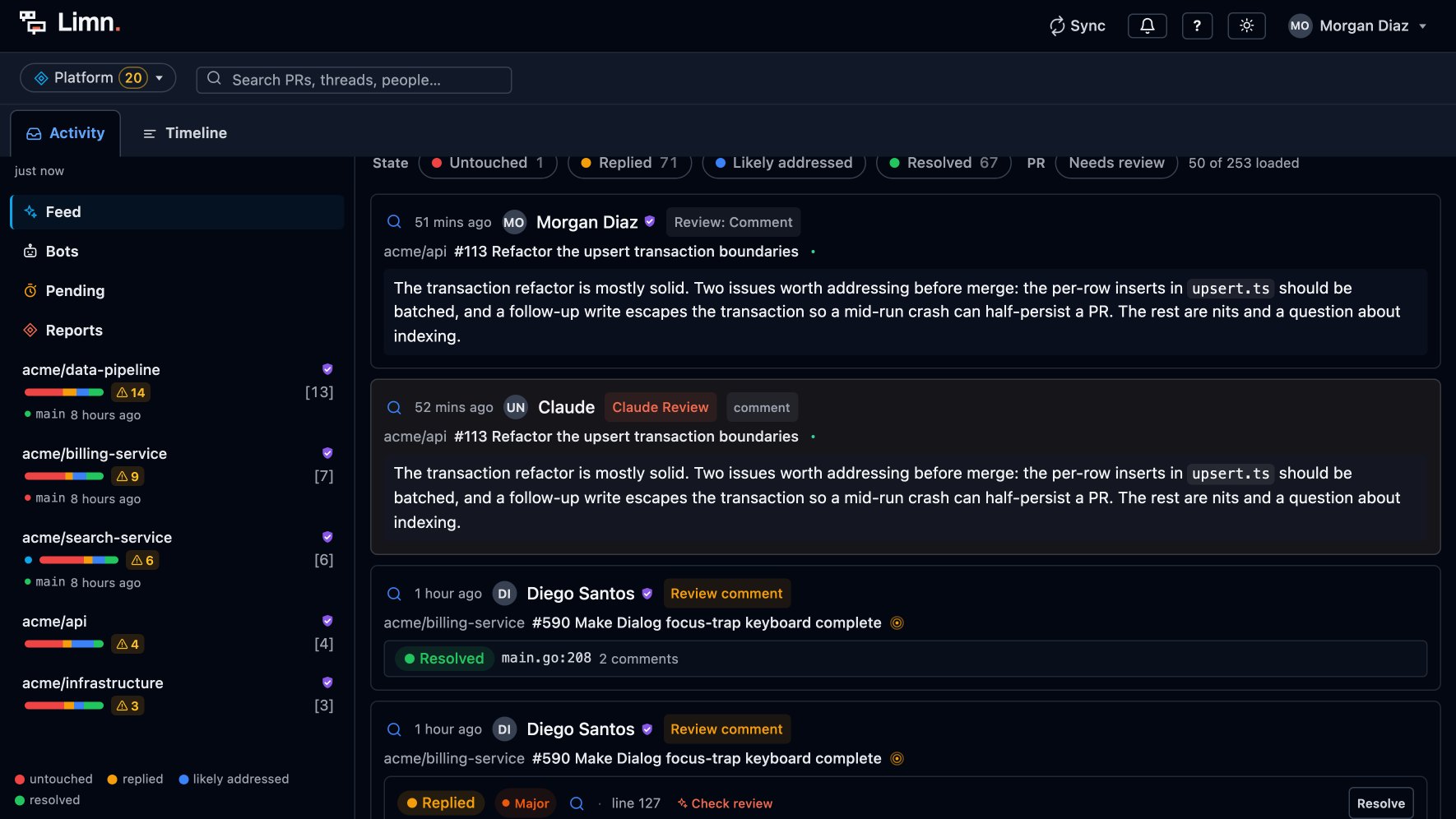
- Feed0:00Every repository in one stream: pull requests, reviews, comments and builds.
- Timeline0:04The same work on a clock. Who opened what, when a review landed, what has been sitting.
- One pull request0:08Review standing, every bot that has looked at it, and whether it can land.
- Was it dealt with?0:13A bot raised a concern and the branch moved on. This reads the diff since, and says what is still open.
- Bots0:18Every review bot: how much it says, how much your team acts on, and how often it overstated a finding.
- Reports0:23Throughput, lead time and review load, with people counted apart from automation.
A seeded eight-repository workspace, so the names and the numbers are invented. The software is not.
More is shipping. It is waiting longer. And everyone claims first place.
more PRs merged since AI-assisted coding took hold
longer those PRs now spend waiting in review
the measured relevance of the average bot review comment
vendors claiming #1 on the same code-review benchmark
Sources: Faros AI, 10,000+ developers · Fatima et al., arXiv, April 2026 · the vendors’ own blogs, 2026.
Built for the engineers keeping up.
A review loop runs across whatever shape your code is in — one repository or twenty, a monorepo or a fleet of services. What changed is the volume moving through it. AI multiplied both halves at once: more pull requests, and far more commentary on each one.
The pace isn’t coming back down. So the tools have to come up.
To limn something is to bring it into enough light to see its shape — the word comes down from the Latin for illuminate. That is the whole idea: complexity you can see is complexity you can manage. The churn stays out there; you get the calm layer above it.
Which cuts both ways, and that is the part worth holding onto. A light shows you what is actually there. It does not invent what is not — so where the data will not carry a claim, Limn says so in words instead of filling the gap with a number.
If you write the code
Your day arrives out of order: a build to fix here, a review to answer there, six bot comments on the one you thought was done, a conflict that appeared overnight. Limn plans it across every repository, by rules you set, and puts the next thing at the top.
- Your day, planned across every repository — a red build, an unanswered review, a stale thread, a conflict — in six ranked tabs.
- By your rules: what counts as your turn, what order it comes in, and which repositories may interrupt you.
- And the top of it is finishable in place — reply, approve, merge, clear the conflict, without leaving the app.
If you run the team
Where the effort went, how long it waited, and what the review automation cost — counted the same way in every repository. Limn measures the whole loop on your own data, and refuses the questions that data will not support.
- Throughput, lead time and reach per repository, with people counted apart from automation. Free.
- A forwardable report per sprint, and an hour-by-hour account of who was holding each pull request.
- And a keep / tune / rarely used verdict on every review bot you pay for, priced per comment your team used.
How the work actually moved.
Throughput, lead time, and how long a pull request waited for its first human review — across every repository at once, with people counted apart from automation, because a blended median describes no pull request anyone wrote.
Free on every tier. Pro turns the same numbers into a stored report per sprint you can forward, and an hour-by-hour account of whether the waiting sat with a reviewer or with the author — with nobody named.
And the automation stacked on top of it.
A team can be running two to six review vendors at once, and none of them reports on itself. Limn grades every bot comment independently, with a purpose-trained classifier that, graded blind against a human expert, picked the same severity seven times in ten — where the vendors’ own badges managed fewer than five. Free, on every tier.
Pro turns those grades into a scoreboard: how much of what each vendor said your team acted on, what that came to per comment, how often it called something major that was not — and where all of it sits against a cohort of 2,204 repositories.
Or run the whole thing on your own machine.
One command, your existing gh login, a SQLite file on your disk. No hosted backend and no stored credentials. Claude review and fix run only here, on your own Claude Code or Anthropic API key; the hosted app has everything else.
npx limn-review
Free answers one pull request. Pro answers the fortnight.
Limn is open core. The free tier is the product, not a trial — it has no repository limit, no user limit and no expiry, and every action you take on a pull request lives in it. Pro is what happens when you need the same truth one grain up: across repositories, across people, across a period.
What should I work on today?
Pending: everything waiting on you or your workspace, across every repository, in six ranked tabs — the top five of each marked Do next.
Plan my day: a written headline, a line on what can wait, and a reason on each planned card. The order stays the free one.
Can I change what counts as my turn?
Yes. Switch card types on or off, move your own work into My turn, set the order, choose how every tab ranks, and mute a repository or a workspace.
Everything free does. Your rules are never the paid part.
What happened on this pull request?
Every thread triaged — untouched, replied, likely addressed, resolved. Blast radius, blockers, merge verdict.
A short written summary, a read on what a red build means, and a check on whether a comment was really addressed.
Can I act without leaving?
Reply, resolve, approve, merge, merge-when-ready, update from trunk, resolve conflicts hunk by hunk.
Everything free does. Acting on a pull request is never the paid part.
Can Claude review or fix this?
Yes, on your machine, on your own Claude: a review you tick and post, a chat on it, and a fix that is pushed only when you click.
Everything free does. The agents are never the paid part.
Which review bots are worth their seat?
Detect every bot, name it, set its role and record what it costs — and an independent severity grade on every comment it leaves.
The per-bot scoreboard: keep / tune / rarely used, dollars per comment your team acted on, over-calling as a weekly line.
How does that compare to other teams?
—
Your bots placed against a 2,204-repository cohort, with a written refusal wherever the cohort is too thin to answer.
How is the team doing?
Flow metrics for the workspace, activity and reach by repository, open pull requests and trunk health.
A stored report per sprint or month, compared like-for-like against the last one, with the coverage stated.
Is a repository about to bite us?
Default-branch health across every repository, the checks failing on it, and the pull request that landed its latest commit.
Everything free does. Trunk health is never the paid part — it is the thing you need at the worst moment.
Where is the time actually going?
—
Chronology: every open hour attributed to a reviewer, an author, or waiting to land. Nobody is named.
What do I take into a one-to-one?
—
A report with a section per person you pick. Preparation, not a ranking — there is no leaderboard anywhere in it.
Can I keep the noise down?
Bots hidden by default, notifications only for work that is yours, and a mute per repository or per workspace.
Everything free does, plus a Slack digest per workspace if you would rather read it there.
Where does it run?
npx limn-review on your machine, or the hosted service. No repository limit, no user limit. Claude review and fix run on your machine only.
The same two places. Pro unlocks on whichever one you already use.
Pro lists at $25 per user, and is free for a month to anyone who asks for it. A user is someone who signs in — bots never count, and there is no per-repository charge.
Review and fix run locally only, on your own Claude Code or Anthropic API key. Limn stores no key and charges nothing for it.
What a free account actually sees. The paid panes are listed and locked rather than hidden, so you can tell what you are not buying before you buy it — and the free metrics above them are the ones that moved here off another tab.
Start free. Every repository, nothing missed.
Sign in with GitHub and the first repositories are on screen in a couple of minutes, or run the whole free tier on your own machine and keep the data there. For Pro, send a message — it is free for a month, for asking.
Card payments are not switched on yet, so Pro is not sold from this page — it is given, a month at a time, to anyone who asks. No card, nothing to cancel. Or run the free tier locally: npx limn-review